06 October 2010

Stone Soup

In the children's book Stone Soup by Marcia Brown, three soldiers wander into a town searching for food. Through the soldiers' encouragement, the towns members all contribute a little bit of what they can into a large pot of "stone soup." In the end, the townspeople learn that when everyone shares and contributes what they have to one great big pot of soup, a delicious meal is created.


This not only applies to soup, but to design as well. Despite the fact that only one name is known on a piece of apparel (take for instance, Ed Hardy, Louis Vuitton, or Calvin Klein), there are usually a team of people that work together to produce an item. A few years ago, I met a family friend of mine who works for Ed Hardy. While we walked around a shopping mall, he pointed to a sneaker and said, "Oh, I designed that one." I was in awe as I replied, "Wow, you design these sneakers for Ed Hardy?" He then explained to me that he was just one of a large group of designers that contributed to the making of the designs and the shoes. I had always thought that a design was only done by one main designer. However, since then, I have learned that design is very much a field where both individuals and groups of people come together to create something fresh.

By taking part in the stone soup activity in class yesterday, the idea of contribution for creation has been reinforced. If everyone had worked alone, I don't think that we could have created the great works that we did. This activity really brought us together not only as thinkers but as a community, too.

Here are some examples of our creations below:

Our group


Other groups


Photo Credits:
viatouch.com
Jenny Fan
Amanda Yib
Kim Losenara
Amanda Yib

04 October 2010

Design in Sailor Moon

After reminiscing about my happy childhood memories of singing along with the theme song to Sailor Moon on TV, I had the urge to relive the song. Thus, to youtube.com I went. And it did not fail me! There it was, the first link, with the song and the opening animations to accompany it. My room mate heard it and suggested that we watch the first episode to reminisce some more. And so we did. As we were watching it, both of us were very surprised by how mediocre the animations were. The characters looked exactly how we had remembered. However, the overall quality was a little blurry and pixelated. The transitions between scenes looked similar to transitions in a powerpoint slide and there were minimal effects done. We thought to ourselves "How did we think that this was so cool when we were younger?"

Sailor Moon Episode 1, Part 1


Putting this into perspective, it is a great example of how far we've come since twelve years ago! Technology has greatly advanced and so has the film and animation industry. Along with this development, people's expectations of film and animation have risen as well. Thinking about it, when I was a child, I know that I didn't pay much attention to details such as special effects and such. It was the characters, plot, and music that kept me a loyal fan. Now that I am more aware, to some degree, of how animation and design is done, I look out for it. And I ask for more from it. While I was watching that first episode, I was asking questions about why the characters werre given the costumes and outfits that were drawn. Is it silly that I am analyzing an old cartoon?


Photo Credit:
Sailor Moon Videos

03 October 2010

Early memories

I love to sing and do karaoke. When I was a child, one of my favorite games to play with my sister was to pretend that we were famous rock stars or performers and stand in front of the TV, singing into a toy microphone. It looked very similar to this one below. In fact, it might have been this very one, though I don't remember very well.

I do remember that it was bright and colorful, like this one. Among all the toys in my toy box, I was always able to easily find this because of its eye-popping neon colors! And it was just the right size for my tiny, child hands. I would pick up my toy mic parade around and sing along with the theme songs to my favorite TV shows, such as Sailor Moon and Pokémon...Ah, the fond memories.

Oh, but one of the greatest aspects of this toy mic is that it echoed! It didn't need batteries or electricity or to be connected to the TV or anything (despite the fact that there is a wire in the picture; in actuality that wire did not exist). I suppose it had something to do with the mechanics inside of it. I loved to hear my voice being projected back in a vibrated sort of way. It really made my pretend game feel more real. But, for the most part I just enjoyed hearing my voice sound funny, much like how other children like to talk in front of a fan because your voice sounds like it's all robotic and scratchy.

I did a lot of talking into fans when I was younger as well.

Photo credits:
Communi-kit
Facebook

28 September 2010

Design in Society

As emphasized in class, design is everywhere. Not everything is design, though. A design is something that is produced and created by man, by humans. So, things that are natural and found in nature, such as leaves, vines, and bugs, aren't design.

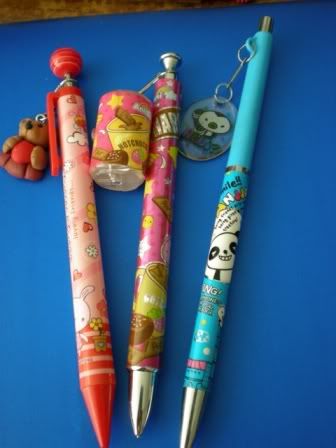
When you look around, though, design can be found in the simplest of things, from buildings to clothes to even pencils, such as these cute mechanical pencils!

The bright colors draw a person's eye to the item, and the little animal images are fun and whimsical. The cute theme of these pencils is clearly geared towards a female audience.

I think that many people don't even realize how design has such an impact upon our lives. People take for granted the things they have and see everyday. I know that I, too, didn't think much about design before considering it as a career in the near distant future.

Now, whenever I look at something I consider what I am looking at. I look at colors, shapes, orientation of the objects in the picture, ect... I think about what kind of mood that the piece is exuding, and what kind of idea that the piece is trying to convey.

Yet even if one does not realize in such clear terms what each aspect of a piece means, they can still experience the feeling that a piece can give off, which is kind of like the mood I was talking about earlier. A piece that can most clearly convey a particular mood to a person is probably the effective because that is part of what design is: shouting out a visual message.

Photo Credit:
Photobucket