Design your world.
Look at the world through my eyes...
30 January 2011
Jooze Juice!
These are juice boxes but it's too bad that they aren't real! The juice boxes shown are just prototypes for a project, I believe. Such great design, color, and appeal! I wish they were real!
Photo Credit:
Luuux.com
06 January 2011
05 January 2011
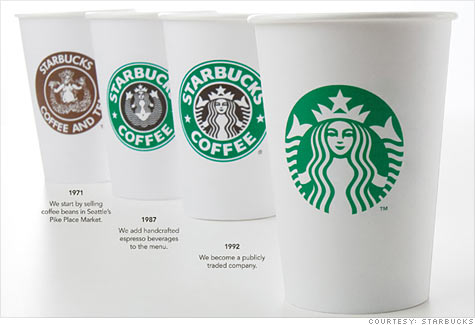
Starbucks Changes Logo
Again! This is to commemorate the 40th anniversary of it's beginnings. Now, the new logo features the mermaid as green (instead of black), a larger image, and removed the words "Starbucks Coffee," signaling an expansion of the brand, beyond coffee.

There seems to be much controversy over the logo change (much like with GAP's logo change). But, in my opinion, the change is very fitting for what Starbucks' future intentions are.
Photo Credit:
CNN Money
There seems to be much controversy over the logo change (much like with GAP's logo change). But, in my opinion, the change is very fitting for what Starbucks' future intentions are.
Photo Credit:
CNN Money
14 December 2010
Amazing Egg House!
I read these articles a while ago and found them very fascinating, but forgot to blog about them. It's really fascinating! A man has made his own little house! Enjoy the articles! Tell me what you think!
mother nature network
China Hush
mother nature network
China Hush
11 December 2010
Experience Through Music
So, I'm sitting in Sacramento International Airport right now, waiting for my flight, enjoying free wi-fi. I was reading articles from the New York Times, attempting to catch myself up with the world, since the whole week I had been confined to my little bubble world of studying for finals, eating, and sleeping.
So, anyways, I came upon this particular article titled, "Canvas? Paint? No, Just Sound," and was very intrigued by what I read. Susan Philipsz is the winner of this year's Turner Prize, which is generally given to a British artist under 50 years of age, thought to push the boundaries and definitions of "art." Philipsz prize-winning work was music, as you can tell from the title of the article. All it is, is an empty, white room with three speakers and some benches. Her voice sings an old Scottish song.
According to the article, many people do not know how to react after hearing her work. Others say that they do not feel very connected to her work because of thier surroundings being so stark and plain. They feel that her song can only truly be appreciated when in the right setting, like on the beach where it was recorded.
But, I think that the perspective from which these commentators are approaching her work is what is keeping them from appreciating her music. I think that Philipsz purposely chose to leave the room empty and unadorned because she wants the audience to focus just on the music, on her voice. It's not about where they are, it's about what they are listening to. The music should be what takes them through an experience. Reading this really reminded me of John Cage and his view of music.
I would love to experience her work myself someday.
Photo Credit:
The Telegraph
29 November 2010
Dangerous Design: Mercury Thermometers
What is one of the first things you do when you feel sick or think you might have a fever? You pick up a thermometer, of course. Thermometers enable you to check your body temperature in order to diagnose whether or not you have a fever or flu or other sickness. They are cylindrical, thin, and clear, allowing one to easily stick it in their mouth our under their arms, or in other places where you can take one's temperature... Originally, thermometers were created using the element Mercury because it has a very low freezing temperature (-38.83 °C or -37.89 °F) and a very high boiling temperature (356.73 °C or 674.11 °F). These extreme temperatures allow it to accurately take human temperature. Thus far, the design of the thermometer is very ergonomic and straight-forward.
However, Mercury is a very dangerous and poisonous substance. It can cause severe health problems and illnesses, including short-term memory loss, brain and nervous development in children,and even death. People had not known that Mercury was the cause of such horrible health issues. It was only recently, in the twenty first century that the U.S. and other countries began banning and reducing the use of Mercury products. Instead, they encourage the use of digital thermometers, which do not contain mercury. Digital thermometers can also be very accurate (you won't have to twist it around and around, like a Mercury thermometer, in order to see where the liquid increased to) and more sturdy than Mercury thermometers. Also, the design of digital thermometers is clear and simple. There is just button that must be pushed in order to read a person's temperature. Then, the numbers pop up on the screen. In discovering the dangers of Mercury thermometers, a path was paved for digital thermometers.
Photo Credits:
Oracle ThinkQuest, Mercury Matters
Basal Digital Thermometer
Utopian Design in Sporks
Take a spoon and combine it with a fork, and you get a "spork." Sporks generally look like a spoon with short fork tines at the end, like the one in the picture above. They an be made with a number of materials, such as plastic, bamboo, aluminum, stainless steel, or titanium. Recently, titanium sporks have become quite popular among those who go hiking or camping. Sporks are convenient to pack because they can do the job of both spoons and forks with just one utensil. Moreover, they are ergonomically designed since they are lightweight (especially the aluminum ones) and easy to carry around. When on a trip, sporks do not take up much space. Also, they reduce the amount of dishes you have to wash, which also saves time. It seems like common sense to have a spork instead of a spoon and a fork.
In recent years, the goal for sustainability and environmental friendliness has become more important than ever. In response to this global concern, there has been the design of "ethically made" sporks, specifically Guyot Designs MicroBites, as pictured below. These two utensils offer even more versatility and can be used in five different ways: as a spoon, fork, knife, spatula, and spreader. Furthermore, they are made from reclaimable nylon, and they are actually carbon negative. Carbon negative means that the processes used to make the product remove more carbon from the atmosphere than they release. I'm not sure how this happens, but it is really great!
Sporks are definitely a great example of utopian design. They are simple, convenient, and they can benefit not only human society, but our whole earth.
Photo Credit:
HubPages, Sporks and Foons
REI, Guyot Designs MicroBites Utensils
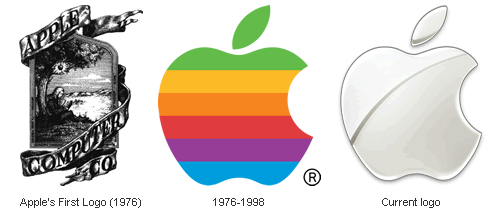
Colors and the Transformation of the Apple, Inc. Logo
Apple, Inc. has changed hier logo completely from 1976 up until now. A shown above, the first logo started off with a very detailed, heavy, and black and white illustraiton of Isaac Newton sitting under and apple tree. Then, that same year, the logo was changed because it was beleived that the slow sales were due to the logo. The new logo became a very simplified bitten apple with rainbow stripes running horizontally. In 1998 the logo was changed again. The current one is similar to the last one in shape, though it is a bit smaller in size. The major change to the logo is in the color. The current one is even more simplified with monochromatic tones of grey and white for shading and a curved grey streak arcross the middle of the apple.
From Josef Alber's book, Interaction of Color, we learned that colors are subjective. Each person views colors in their own ways. Also, the colors we percieve are never truly at thier purest; they are constantly being affected by the colors around them. The 1976-1998 logo was a rainbow of solid, bold colors laid side by side. This design is very eye-catching, and no matter who is looking at it or from which ever perspective, the colors simply stand out because of the order they are in, which contrasts them. This pop of bright colors probably made Apple, Inc. stand out and become a memorable symbol.
Even today, the Apple, Inc. logo is easily recognized and remembered. However, as stated before, the current logo is much less bright, and is much more monochromatic. This lack of color shifts the focus of the design from the color of the apple to the apple itself. This shows how Apple, Inc. is now a well-known and stable brand, and they intend to stay a modern, forward-thinking company, as the smooth, sleek streaks on the apple illustrate. Moreover, the monochrome greys and whites are reminiscent of strong, sure metals, such as steel and iron.
Colors, and the lack of colors, can have a huge impact on design, and the Apple, Inc. logo is just one example of many.
Photo Credit:
Neatorama
Photo Credit:
Neatorama
13 November 2010
Designing With Seeds of Life
If you had the chance this year to visit the Shanghai World Expo 2010, which ran from May 1st to October 31st, then you know that there were over 230 amazing exhibitions to visit. However, I bet that there was one showcase that left a definite impression: the UK Pavilion, also known as "The Seed Cathedral."

Designed by the popular British designer Thomas Heatherwick, this 20 meters (65.6 feet) high structure is made up of 60,000 slender rods that are each 7.5 meters (24.6 feet) long. In collaboration with the Kew Gardens and Millenium Seed Bank Project, each rod contains a seed (which can be viewed inside the Seed Cathedral) or two from a plant species. Visitors can walk around, inside the cathedral and observe the various seeds. This gigantic "dandelion," as it is aptly nicknamed by the Chinese, absorbs sunlight in order to illuminate the interior, and then when it is dark, the light saved up also lights up the outside of it, giving it a "glow."

When I had initially read about this, I was amazed at the design and architecture of this building because it looks so astounding and surreal. The fiber optic rods are all identical, bringing a continuity through repetition into the design. Inside the cathedral, it is dimly lit by the rods, which are everywhere, above and around, as if enveloping a person.

I am still not exactly sure how each rod is held up in place, but it is certainly an architectural and physical feat. It looks as if all the seed rods are growing out of a single point, and I think this is part of the message that Heatherwick is attempting to convey: that all living things on earth are connected and affected by each other. Each seed that is on display is a single, unique species of plant that one day could be extinct. Not only are the rods designed so that they appear to be pointing inward, towards a common origin, but they also point outward, signifying that this is not an issue that only concerns a few organizations, but it concerns people all around the world. I think that when people tour this structure they will get a sense of how people, too, are part of the cycle of life and their decisions can decide what happens to millions of other species.

"After the Expo, just as dandelion seeds are blown away and disperse on the breeze, the Seed Cathedral's 60,000 optic hairs, each one containing the huge potential of life, will be distributed across China and the UK to hundreds of schools as a special legacy of the UK Pavilion at the 2010 Shanghai Expo." --Thomas Heatherwick
Photo Credits:
TreeHugger
PopSci
PopSci
PopSci
Designed by the popular British designer Thomas Heatherwick, this 20 meters (65.6 feet) high structure is made up of 60,000 slender rods that are each 7.5 meters (24.6 feet) long. In collaboration with the Kew Gardens and Millenium Seed Bank Project, each rod contains a seed (which can be viewed inside the Seed Cathedral) or two from a plant species. Visitors can walk around, inside the cathedral and observe the various seeds. This gigantic "dandelion," as it is aptly nicknamed by the Chinese, absorbs sunlight in order to illuminate the interior, and then when it is dark, the light saved up also lights up the outside of it, giving it a "glow."
When I had initially read about this, I was amazed at the design and architecture of this building because it looks so astounding and surreal. The fiber optic rods are all identical, bringing a continuity through repetition into the design. Inside the cathedral, it is dimly lit by the rods, which are everywhere, above and around, as if enveloping a person.
I am still not exactly sure how each rod is held up in place, but it is certainly an architectural and physical feat. It looks as if all the seed rods are growing out of a single point, and I think this is part of the message that Heatherwick is attempting to convey: that all living things on earth are connected and affected by each other. Each seed that is on display is a single, unique species of plant that one day could be extinct. Not only are the rods designed so that they appear to be pointing inward, towards a common origin, but they also point outward, signifying that this is not an issue that only concerns a few organizations, but it concerns people all around the world. I think that when people tour this structure they will get a sense of how people, too, are part of the cycle of life and their decisions can decide what happens to millions of other species.
"After the Expo, just as dandelion seeds are blown away and disperse on the breeze, the Seed Cathedral's 60,000 optic hairs, each one containing the huge potential of life, will be distributed across China and the UK to hundreds of schools as a special legacy of the UK Pavilion at the 2010 Shanghai Expo." --Thomas Heatherwick
Photo Credits:
TreeHugger
PopSci
PopSci
PopSci
Criticism on Water Bottles
Water sustains life. We need water bottles to carry our water around. Thus, water bottles were created. Plastic water bottles are sold world-wide. Aluminum water bottles popped up in an attempt towards environmental activism. However, stainless steel water bottles were later born due to health issues.

A popular brand of stainless steel water bottles, Klean Kanteen, is a great example of ergonomically designed, functional water bottles. What's more they are also environmentally friendly. They are better for the environment because of their re-usability, which prevents plastic water bottles from being used and thrown away, which equals less landfill, which equals a cleaner world. As far as sustainability and safety goes, stainless steel water bottles are the way to go. Water bottles made of stainless steel are free of BPA (Bisphenol A), which is a chemical found in the manufacturing of plastics and aluminums. BPA is dangerous because it can negatively affect one's body by disrupting hormones. Cleanliness is important to safety, too! The general design of Klean Kanteen bottles is full of rounded edges and curves, which prevent any dirt, germs, or bacteria from building up on the bottle.
Klean Kanteen bottles are, overall, comfortable to use, in that the bottles are rounded, which allows easy handling and gripping of them. However, I think that if the bottles curved a bit inward towards the middle it would even easier to keep a hold of them. If they were a little thinner around the middle, then the ends would be a little larger to enable one's hand to stay in place in the center. To get a better idea of what I mean, imagine a small hand weight, but one that is more rounded. This is actually the design that I am referring to:

Klean Kanteen bottles are also very easy to use and to clean. The lid twists on and off, and it also prevents leakage with a small ring of rubber and suction. The lid also has a loop on it so that it is easy to pick it up and attach it to things. Thus, one can keep it on a backpack or a bag and carry it around when on-the-go. Moreover, the mouth of the bottle is large so it is easy to pour water into it and drink from it.

Since these bottles are made of stainless steel, they are meant to be durable and to last a while. As stated before, they are re-usable and refillable. Klean Kanteen bottles definitely perform their function well. Furthermore, they are aesthetically pleasing. Many different sizes of bottles are offered for multiple uses. Recently, the company has released many new colors for consumers to purchase, widening variety and interest. They have also begun selling small, 12 ounce "sippy" bottles, which appeal to mothers and young children. Each bottle is decorated simply with the company's name, "Klean Kanteen" in a clean-cut, sans-serif font, representing modernity and simplicity. Their logo, a globe, is also present, symbolizing their goal for a cleaner world through sustainability and eco-friendly products.

Photo Credits:
Outdoor Pros
Vessel Drinkware
Ed's Green Blog
Go Green In Stages
A popular brand of stainless steel water bottles, Klean Kanteen, is a great example of ergonomically designed, functional water bottles. What's more they are also environmentally friendly. They are better for the environment because of their re-usability, which prevents plastic water bottles from being used and thrown away, which equals less landfill, which equals a cleaner world. As far as sustainability and safety goes, stainless steel water bottles are the way to go. Water bottles made of stainless steel are free of BPA (Bisphenol A), which is a chemical found in the manufacturing of plastics and aluminums. BPA is dangerous because it can negatively affect one's body by disrupting hormones. Cleanliness is important to safety, too! The general design of Klean Kanteen bottles is full of rounded edges and curves, which prevent any dirt, germs, or bacteria from building up on the bottle.
Klean Kanteen bottles are, overall, comfortable to use, in that the bottles are rounded, which allows easy handling and gripping of them. However, I think that if the bottles curved a bit inward towards the middle it would even easier to keep a hold of them. If they were a little thinner around the middle, then the ends would be a little larger to enable one's hand to stay in place in the center. To get a better idea of what I mean, imagine a small hand weight, but one that is more rounded. This is actually the design that I am referring to:
Klean Kanteen bottles are also very easy to use and to clean. The lid twists on and off, and it also prevents leakage with a small ring of rubber and suction. The lid also has a loop on it so that it is easy to pick it up and attach it to things. Thus, one can keep it on a backpack or a bag and carry it around when on-the-go. Moreover, the mouth of the bottle is large so it is easy to pour water into it and drink from it.
Since these bottles are made of stainless steel, they are meant to be durable and to last a while. As stated before, they are re-usable and refillable. Klean Kanteen bottles definitely perform their function well. Furthermore, they are aesthetically pleasing. Many different sizes of bottles are offered for multiple uses. Recently, the company has released many new colors for consumers to purchase, widening variety and interest. They have also begun selling small, 12 ounce "sippy" bottles, which appeal to mothers and young children. Each bottle is decorated simply with the company's name, "Klean Kanteen" in a clean-cut, sans-serif font, representing modernity and simplicity. Their logo, a globe, is also present, symbolizing their goal for a cleaner world through sustainability and eco-friendly products.
Photo Credits:
Outdoor Pros
Vessel Drinkware
Ed's Green Blog
Go Green In Stages
08 November 2010
Words and Images in Sailor Moon
This morning, my room mate returns from her weekend at home and exclaims, "Guess what?"
"What?"
"So, I was looking to order the second and third volumes of Sailor Moon, but they're out of print! And people on Amazon and eBay are selling them used from fifteen dollars upwards to nearly two hundred dollars!"

Needless to say, I was shocked. I've always found it strange how things are worth more after the creator is dead than when they are alive. Though, I know it's because the items are then considered a rarity and limited editions. No more of the same products will ever be made by the former hand again.
I'm pretty sure that it was the anime that made Sailor Moon so mainstream, since it was available for the public on TV. Though, Sailor Moon was popular in print, as well. Going back to the concept that word and image are so much more powerful when they are combined, than when they are used individually, the same applies, of course, to manga, or Japanese comics.
"What?"
"So, I was looking to order the second and third volumes of Sailor Moon, but they're out of print! And people on Amazon and eBay are selling them used from fifteen dollars upwards to nearly two hundred dollars!"
Needless to say, I was shocked. I've always found it strange how things are worth more after the creator is dead than when they are alive. Though, I know it's because the items are then considered a rarity and limited editions. No more of the same products will ever be made by the former hand again.
I'm pretty sure that it was the anime that made Sailor Moon so mainstream, since it was available for the public on TV. Though, Sailor Moon was popular in print, as well. Going back to the concept that word and image are so much more powerful when they are combined, than when they are used individually, the same applies, of course, to manga, or Japanese comics.
Flipping through Sailor Moon StarS: Volume 1, I came upon two pages that I thought reflected the concept of words and images working together. In the first page, one can see that there is the panicked face of a character and that crows fill the page, representing evil and chaos. The large, rough font of the sound effects, "kwaa" (the sound the crows make) and " whirrl" (the crows' wings), emphasize the dark mood of these panels. On the second page, the mood is completely different. It is calm and quiet. The words "float" are in bubble letters and they look light and airy in order to underline the serenity our the girl floating out of the sky.
While I was examining these pages, I noticed that McCloud's remarks on how Japanese comics incorporate more "aspect-to-aspect" transitions is very true. In these two pages, there are already four or five "aspect-to-aspect" transitions.
Photo Credits:
Naoko, Takeuchi. Sailor Moon StarS. 1. Los Angeles: Tokyopop, 2001. 59, 136. Print.
07 November 2010
Silent Secrets
Thinking of vacationing in Cancun, Mexico anytime, soon? If you are, be sure to go diving off of Isla Mujeres because there, at the bottom of the sea, waits an amazing sight.


These sculptures, each unique and cast from real people, are only a small portion of Jason deCaires Taylor's project, "La evolución silenciosa" ("The Silent Revolution"), which is one of four installations at the Museo Subacuático de Arte (MUSA), located in Cancun's National Park. Each sculpture is made of "inert, pH-neutral concrete" that is safe for animals and plants underwater and does not pollute the water (Gadling). The sculptures serve to promote the growth of coral reefs and sea life. They are also an effort towards "the art of conservation," and the museum hopes to increase awareness of the decline of coral reefs and biodiversity through this exhibit. Moreover, they encourage visitors to return multiple times in order to see how the ocean changes and grows and nurtures an ecozone.
This project is a great example of how design can be used to get across a message. I think that the title "The Silent Revolution" is referring to the fact that many people aren't aware of how their everyday actions, such as littering and dumping wastes and chemicals into the sea, and fertilizer run-off, can affect other living creatures. The ocean and the creatures in it can't communicate with humans to tell of of these things so, of course, so they are "silent." By placing sculptures of actual people on the ocean floor, Jason Taylor seems to be telling people that we have a responsibility, too, because the pollution is caused by humans, and it will eventually affect humans.
Someday I hope to visit this underwater museum myself and see these awesome statues and the sea life that has benefited from it.
Photo Credits:
06 November 2010
Word and Image with Brian Fies at UCD
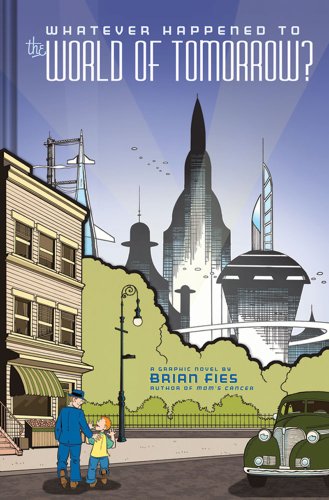
Brian Fies presentation in design class on Tuesday was truly inspiring and eye-opening. He had initially started off as a chemist, and there he stood before us as a published graphic novelist. (I thought that was really cool, since I, myself, have an interest in science, but I've decided to major in design.) His graphic novels, Mom's Cancer and Whatever Happened to the World of Tomorrow?, both have won much praise and awards.
Mr. Fies was really honest about his works and how they came to be. I liked how he had a personal connection to his books, and I thought that it was very evident in his comics. He spoke about how the words and images came together to produce something better than each of them would have been standing alone. McCloud also underlined this point in his book, Understanding Comics. Words on their own can allow the reader to imagine their own images; and pictures free the viewer to create their own dialogue. But when both are combined together, the artist is able to convey a more specific idea to his audience, they present the true concept and message of the artist. Fies pointed this out to us through his powerpoint, highlighting specific panels in his graphic novels, such as the panel with his mom in pieces, and the conversation between his mom and sister having two different versions. As I read Mom's Cancer I noticed many more panels that also presented how powerful words and images working together can be.
01 November 2010
Shoes Over Time
I was walking to my usual study spot at the library, when I saw a book that stood out to me, titled "The Seductive Shoe: Four Centuries of Fashion Footwear" by Jonathan Walford. I picked it up, out of curiosity, but I was soon engrossed in it because of all the fascinating information (and all the great pictures!). In each chapter, Walford discusses which shoe styles dominated that time period, and how and why those shoes were popular. Through this organization, one can really see how the style of shoes around the world have evolved and changed over time. It captures the "zeitgeist" of fashion during those eras very well. They also show what kind of technology and economy the country had at the time.
One can only make shoes out of materials one has. For instance, flat-soled shoes made of leather were one of the only kind of shoes made until the late sixteenth century, when heels were beginning to be added to shoes. This shows that leather was a material that was easy to get a hold of. Later on, when the Italian Renaissance and trade between Europe and East Asia occurred, new materials were introduced, such as silks and other textiles. This allowed shoe makers to explore new depths in shoes and design.
Since then, the shoe industry has come a long way. With more resources and ideas than ever, there have also been more crazy ideas than every, especially concerning the heel-less shoe.

Manolo Blahnik, 2006

Marc Jacobs, 2008
Looking at these shoes from a design aspect, the brown one looks like it is pretty balanced because of the continuity and flow of the straps. However, Marc Jacobs's eye-popping magenta and sea green shoe seems more chaotic, not only because of the colors, but also due to the construction. The upper portion of the shoe has gentle curves, which are emphasized with the round curls on the front. The sudden angles on the bottom of the shoe are out of place and it makes it look unbalanced. Regardless, I found both of these shoes to be very interesting because of their gravity-defying look. They also look super uncomfortable! Would you ever wear a pair?
Photo Credits:
Roxy is Here
One can only make shoes out of materials one has. For instance, flat-soled shoes made of leather were one of the only kind of shoes made until the late sixteenth century, when heels were beginning to be added to shoes. This shows that leather was a material that was easy to get a hold of. Later on, when the Italian Renaissance and trade between Europe and East Asia occurred, new materials were introduced, such as silks and other textiles. This allowed shoe makers to explore new depths in shoes and design.
Since then, the shoe industry has come a long way. With more resources and ideas than ever, there have also been more crazy ideas than every, especially concerning the heel-less shoe.
Manolo Blahnik, 2006
Marc Jacobs, 2008
Looking at these shoes from a design aspect, the brown one looks like it is pretty balanced because of the continuity and flow of the straps. However, Marc Jacobs's eye-popping magenta and sea green shoe seems more chaotic, not only because of the colors, but also due to the construction. The upper portion of the shoe has gentle curves, which are emphasized with the round curls on the front. The sudden angles on the bottom of the shoe are out of place and it makes it look unbalanced. Regardless, I found both of these shoes to be very interesting because of their gravity-defying look. They also look super uncomfortable! Would you ever wear a pair?
Photo Credits:
Roxy is Here
30 October 2010
Form and Function in the Palm Pre
So many things in our world today are mass-produced, from drinking straws to vacuums to cars. One of the most common mass-produced, industrially designed things that we use today is the cellular phone. We are constantly picking up our phones to check the time, to plan ahead, to text and chat, and, of course, to make calls. Because we do so much with our cell phones nowadays, what people look for when they buy a phone is clarity and directness.
In the film "Objectified" by Gary Hustwit, which I focused in my last post, I mentioned how Hustwit notes that modern technology has caused design to become less focused on the function of the object. Memory is expanding and, at the same time, shrinking (in physical size), and design has seemed to shift away from the purpose of the object.
However, I think that with cell phones, design has pretty much been consistent -- generally rectangular and small -- because that design fits in the palm of one's hand. Speaking of one's palm, the cell phone that I would like to focus on, specifically, is the Palm Pre.

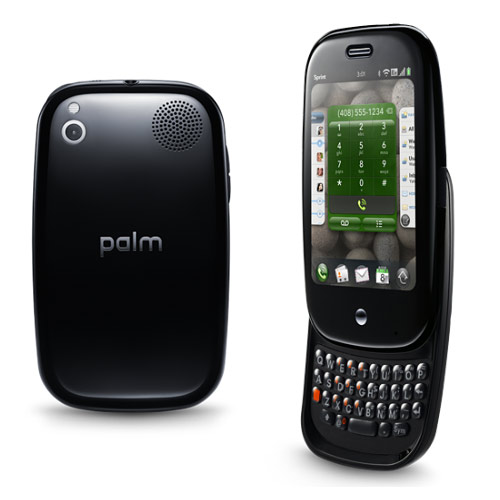
Upon first glance, the most salient characteristics of the phone are the touch screen, the oval-shaped speaker, and round button "home" on the front, the slide-out keyboard, and the camera and speaker on the back. All of these details are quite clear as to what their function is. Also, there is unity and continuity in the general rounded shape of the Palm Pre. The overall shape is repeated within the finer points of the device, such as the rounded-edged keys on the keyboard, the "home" button, and the speakers. The simple, straight lines also give a sense of simplicity and balance. The focal point is, of course, the touch screen which calls our attention the most because of its bright colors as opposed to the color black, which makes up the rest of the phone. This emphasizes that this cell phone is mainly navigated by touching the display.
While many things today are designed without a thought for function, the Palm Pre is not one of them.
Photo Credit:
Liquid Matrix
In the film "Objectified" by Gary Hustwit, which I focused in my last post, I mentioned how Hustwit notes that modern technology has caused design to become less focused on the function of the object. Memory is expanding and, at the same time, shrinking (in physical size), and design has seemed to shift away from the purpose of the object.
However, I think that with cell phones, design has pretty much been consistent -- generally rectangular and small -- because that design fits in the palm of one's hand. Speaking of one's palm, the cell phone that I would like to focus on, specifically, is the Palm Pre.
Upon first glance, the most salient characteristics of the phone are the touch screen, the oval-shaped speaker, and round button "home" on the front, the slide-out keyboard, and the camera and speaker on the back. All of these details are quite clear as to what their function is. Also, there is unity and continuity in the general rounded shape of the Palm Pre. The overall shape is repeated within the finer points of the device, such as the rounded-edged keys on the keyboard, the "home" button, and the speakers. The simple, straight lines also give a sense of simplicity and balance. The focal point is, of course, the touch screen which calls our attention the most because of its bright colors as opposed to the color black, which makes up the rest of the phone. This emphasizes that this cell phone is mainly navigated by touching the display.
While many things today are designed without a thought for function, the Palm Pre is not one of them.
Photo Credit:
Liquid Matrix
Form and Content in Objectified
The documentary film, Objectified, by Gary Hustwit deals with the everyday objects of our lives and how they are designed. The documentary mentions how people don't even notice the things they use everyday, that is, until those everyday things start to bother them.
One company that the film focuses on is Smart Design, which is a design, research, and consultancy firm located in New York and San Francisco. Much of their work deals with ergonomics, or listening to consumers problems with objects and re-designing the objects to improve them. One project that they worked on was a fruit and vegetable peeler, and how the handle is difficult to grip for people with arthritis. Eventually they came up with the idea of using a bike handle as a template for a new handle since a bike handle is larger and easier to keep a hold on.
As mentioned above, we take for granted the everyday things we use, and we often don't think about how they are designed and how that design affects us. Takahama Kyoshi, a Japanese designer, uses the phrase "design dissolving in behavior." When something is designed well, the use of it is simple and effortless. For instance, Apple products are cleanly and simply designed, and their interfaces are very user friendly, which makes their products very popular.
In design form dictates function; in other words, the form of the object shows how it is supposed to be used. Objectified highlighted the fact that with the more advanced technology we have nowadays, such as microchips and memory cards, we are able to create more complicated products and design them to take and shape or form we want. For instance, cameras were originally made in the classic rectangular shape because film rolls were also large and rectangular. However, modern digital cameras use tiny, square memory cards to keep data on pictures. One could design a camera to any shape and size they preferred. So why are digital cameras still rectangular?
Photo Credits:
New Raleigh
Geek Sugar
18 October 2010
Miniature Obsessions
Why is it that people love things that are smaller or larger than the average? I suppose it's because things that are miniature are not things that often appear naturally in everyday life. So, whenever people see something that is small and cute and adorable, they flock to them.
I definitely saw this phenomenon occur when I was at the annual Art and Pumpkin Festival this past weekend.

I was walking around with some friends, looking at all the booths and all the art! There were a handful of vendors that sold beautiful blown glass pumpkins painted in a myriad of colors and sizes. Despite the variety available, many visitors gravitated towards the mini ones. People were picking them up and with two fingers and carefully examining them and exclaiming over them. I admit that I, too, was one of those people. I think that I was drawn to them because they were so small, and yet they had just as many details and were just as brightly colored as the larger ones. The vines had small grooves and they curled and curved, some vines looking very much like those photographed by Karl Blossfeldt!
It must have taken much skill, time, and patience to create such small wonders.


Things that are larger than life also receive much attention because, again, they are uncommon sights. During the parade, the winner of this year's giant pumpkin growing contest was being paraded down the main street. It was a gargantuan thing weighing in at 1,500 pounds! This, too, must have taken a lot of care and effort to create!
Photo Credits:
Miramar Events
Amanda Yib
Amanda Yib
I definitely saw this phenomenon occur when I was at the annual Art and Pumpkin Festival this past weekend.
I was walking around with some friends, looking at all the booths and all the art! There were a handful of vendors that sold beautiful blown glass pumpkins painted in a myriad of colors and sizes. Despite the variety available, many visitors gravitated towards the mini ones. People were picking them up and with two fingers and carefully examining them and exclaiming over them. I admit that I, too, was one of those people. I think that I was drawn to them because they were so small, and yet they had just as many details and were just as brightly colored as the larger ones. The vines had small grooves and they curled and curved, some vines looking very much like those photographed by Karl Blossfeldt!
It must have taken much skill, time, and patience to create such small wonders.


Things that are larger than life also receive much attention because, again, they are uncommon sights. During the parade, the winner of this year's giant pumpkin growing contest was being paraded down the main street. It was a gargantuan thing weighing in at 1,500 pounds! This, too, must have taken a lot of care and effort to create!
Photo Credits:
Miramar Events
Amanda Yib
Amanda Yib
17 October 2010
Comparison and Contrast
Recently, GAP redesigned it's logo in an attempt to create one that was more forward-thinking and modern. However, this change was met with great uproar as consumers online complained about the new logo's look. Many thought that the logo looked too simple and looked like something any person could create. After a harsh backlash, GAP decided to revert back to it's original logo, but with a slight change. As this article from bnet cleverly points out, the cross bar on the "G" now aligns better with those on the "A" and "P."
After reading about this logo change, I was inspired to look at other companies that had changed or redesigned their logos over the years. As you can see in the image below, many major companies have altered their logos over time.

It is really amazing to look at all these logos and how they look currently as compared to how they began. Many company logos have changed greatly since they began! Each shows a feeling in the "zeitgeist" of that time period. They also show how design has been evolving. A few of them began as very detailed designs, such as Apple, Shell, and Canon. Over the years, we can see that they all became much more minimalistic and simplified.
Canon's original logo was named after and represented "Kwanon" the Buddhist goddess of mercy. It was very detailed and balanced, showing a ring around the goddess for unity. Today the logo is much more simplified. Only its name is presented. The unique font displays letters with sharp, pointed ends and rounded edges, representing precision and continuity. This could reflect the reliability of their products, and the promise of continuing to stay strong in the future.
A logo of a company is significant because it is, more or less, the face of the company. When someone sees a certain company's logo for the first time, that is the company's first impression upon the person.
Photo Credit:
ADHACK
After reading about this logo change, I was inspired to look at other companies that had changed or redesigned their logos over the years. As you can see in the image below, many major companies have altered their logos over time.
It is really amazing to look at all these logos and how they look currently as compared to how they began. Many company logos have changed greatly since they began! Each shows a feeling in the "zeitgeist" of that time period. They also show how design has been evolving. A few of them began as very detailed designs, such as Apple, Shell, and Canon. Over the years, we can see that they all became much more minimalistic and simplified.
Canon's original logo was named after and represented "Kwanon" the Buddhist goddess of mercy. It was very detailed and balanced, showing a ring around the goddess for unity. Today the logo is much more simplified. Only its name is presented. The unique font displays letters with sharp, pointed ends and rounded edges, representing precision and continuity. This could reflect the reliability of their products, and the promise of continuing to stay strong in the future.
A logo of a company is significant because it is, more or less, the face of the company. When someone sees a certain company's logo for the first time, that is the company's first impression upon the person.
Photo Credit:
ADHACK
15 October 2010
Design as a Conversation
Design is most definitely a conversation because language in itself is a kind of design. According to Kostas Terzidis's article, "The Etymology of Design: Pre-Socratic Perspective," the word "design" hails from the Latin word "signare," which means "to mark” or “to sign." In this way, a design is one's sign or symbol, a mark that represents that individual.
In his book, Understanding Comics, Scott McCloud touched upon the history of our modern alphabet. It began as pictures to represent various objects and actions, but later it became increasingly simplified to the point where, today, letters are used to signify particular sounds for our understanding.We give names to things like dogs, canine, cats, and feline. But, labels are relative, and each word has its own subtle connotations. In English, we automatically associate felines with being more feminine and canines with being more masculine.

In the image above, titled Personnage marchant vers l’horizon (Character going towards the horizon), (1928-9), René Magritte depicts a man standing in the middle of a group of blobs with labels on them reading “cloud,” “rifle,” “horizon,” “armchair,” and “horse.” The blobs do not at all resemble the actual subjects that they are supposed to represent. Here, Magritte is attempting to get a message across to his audience, he is trying to start a conversation with his viewers.
From what I can ascertain, the man standing in the middle is mankind; he is at the center of attention, and he is in control of the things around him. The blobs with the labels represent how mankind is the one who gives names to the objects around him. If it weren’t for the labels, the blobs are nothing, they mean nothing. But mankind is the one who imparts significance to these objects.
To analyze this painting further, notice that the man is wearing a top hat and a long coat, representing a western sort of fashion. Here, the meanings of the blobs are French, but what about in other languages? I’m sure that each language and each culture has its own subtle and distinct connotations for each word, as well. For instance, in English, the words "home" and "house" may at first thought seem to be similar, but they are actually very different ideas. A "home" is a place where a person feels most at ease, but a "house" is simply a structure where people live. In English, a "house" is not necessarily a "home," though they sound similar. In Spanish, the words for "house" ("casa") and "home" ("hogar") are distinctly unique and there is a very clear definition between them, which can represent, perhaps, how in Latin cultures that people do not automatically mush together the meanings of house and home, unlike in America.
I think these same ideas can apply to design. Designs viewed across countries and cultures can mean different things to different people because we all have had different experiences that leave different impressions upon us. I remember one day, some years ago, reading up about Takashi Murakami and looking at pictures of his artwork. I was especially taken by his paintings of mushrooms because I like mushrooms and I like to eat mushrooms, and I had never seen mushrooms painted the way he had painted them (with eyes and various, bright clashing colors) To me, it was just a completely new thing, which I thought was fascinating and cute, in a way. However, I watched some video interviews with Murakami and he had explained that to him, the mushrooms represented the giant mushroom clouds of the atom bombs dropped on Japan during WWII. I was surprised. I hadn't even thought of that, while that might have been the first thing on the minds of many people in Japan! I realized then that perspective plays a huge role in design.


Photo Credit:
Words in Images
Collector's Quest, The Takashi Murakami Exhibit in Brooklyn
Helium Foundation
In his book, Understanding Comics, Scott McCloud touched upon the history of our modern alphabet. It began as pictures to represent various objects and actions, but later it became increasingly simplified to the point where, today, letters are used to signify particular sounds for our understanding.We give names to things like dogs, canine, cats, and feline. But, labels are relative, and each word has its own subtle connotations. In English, we automatically associate felines with being more feminine and canines with being more masculine.
In the image above, titled Personnage marchant vers l’horizon (Character going towards the horizon), (1928-9), René Magritte depicts a man standing in the middle of a group of blobs with labels on them reading “cloud,” “rifle,” “horizon,” “armchair,” and “horse.” The blobs do not at all resemble the actual subjects that they are supposed to represent. Here, Magritte is attempting to get a message across to his audience, he is trying to start a conversation with his viewers.
From what I can ascertain, the man standing in the middle is mankind; he is at the center of attention, and he is in control of the things around him. The blobs with the labels represent how mankind is the one who gives names to the objects around him. If it weren’t for the labels, the blobs are nothing, they mean nothing. But mankind is the one who imparts significance to these objects.
To analyze this painting further, notice that the man is wearing a top hat and a long coat, representing a western sort of fashion. Here, the meanings of the blobs are French, but what about in other languages? I’m sure that each language and each culture has its own subtle and distinct connotations for each word, as well. For instance, in English, the words "home" and "house" may at first thought seem to be similar, but they are actually very different ideas. A "home" is a place where a person feels most at ease, but a "house" is simply a structure where people live. In English, a "house" is not necessarily a "home," though they sound similar. In Spanish, the words for "house" ("casa") and "home" ("hogar") are distinctly unique and there is a very clear definition between them, which can represent, perhaps, how in Latin cultures that people do not automatically mush together the meanings of house and home, unlike in America.
I think these same ideas can apply to design. Designs viewed across countries and cultures can mean different things to different people because we all have had different experiences that leave different impressions upon us. I remember one day, some years ago, reading up about Takashi Murakami and looking at pictures of his artwork. I was especially taken by his paintings of mushrooms because I like mushrooms and I like to eat mushrooms, and I had never seen mushrooms painted the way he had painted them (with eyes and various, bright clashing colors) To me, it was just a completely new thing, which I thought was fascinating and cute, in a way. However, I watched some video interviews with Murakami and he had explained that to him, the mushrooms represented the giant mushroom clouds of the atom bombs dropped on Japan during WWII. I was surprised. I hadn't even thought of that, while that might have been the first thing on the minds of many people in Japan! I realized then that perspective plays a huge role in design.
Supernova (1999), Murakami
Posi Mushrooms (2002), Murakami
Photo Credit:
Words in Images
Collector's Quest, The Takashi Murakami Exhibit in Brooklyn
Helium Foundation
09 October 2010
Creativity from Without
If design is everywhere, inspiration everywhere, as well. That is the meaning of "creativity form without," looking outside of oneself for inspiration, as opposed to looking inside. Oftentimes people applaud the creativity they see in famous landmarks, buildings, architecture, and sculptures. However, nature is sometimes overlooked.
Nowadays, the leaves are changing colors and falling all around. The wind blows more often and the temperature is gradually becoming cooler. Autumn is my favorite season because the transition, from the scorching hot summertime to the cold, frosty winters, is so beautiful.
Nature itself is often an inpiration to me because although things like trees, grass, and leaves may seem so simple, they are actually very complex. If you look at a leaf, you will find that there are hundreds of tiny veins running along it, and in various patterns. Look at these leaves:

Flowers, vibrant and colorful and sweet smelling, also have veins in them. Flowers are definitely an inspiration for thier colors and chapes. Take a look at these flowers that can be found right on campus:


The veins on flowers connect the flowers to the leaf,the leaf to the tree, and the tree is connected to the earth. Thus, everything is a network and we are all intertwined in a way. The details and complexitites of nature really inspire me, and I am often in awe of how sublime the natural world is. I would like to someday create something that is like nature, something that seems simple, yet complex, something that has the ability to reach out to the world...
Photo Credits:
Maggie Minero
Maggie Minero
Amanda Yib
Nowadays, the leaves are changing colors and falling all around. The wind blows more often and the temperature is gradually becoming cooler. Autumn is my favorite season because the transition, from the scorching hot summertime to the cold, frosty winters, is so beautiful.
Nature itself is often an inpiration to me because although things like trees, grass, and leaves may seem so simple, they are actually very complex. If you look at a leaf, you will find that there are hundreds of tiny veins running along it, and in various patterns. Look at these leaves:
Flowers, vibrant and colorful and sweet smelling, also have veins in them. Flowers are definitely an inspiration for thier colors and chapes. Take a look at these flowers that can be found right on campus:

The veins on flowers connect the flowers to the leaf,the leaf to the tree, and the tree is connected to the earth. Thus, everything is a network and we are all intertwined in a way. The details and complexitites of nature really inspire me, and I am often in awe of how sublime the natural world is. I would like to someday create something that is like nature, something that seems simple, yet complex, something that has the ability to reach out to the world...
Photo Credits:
Maggie Minero
Maggie Minero
Amanda Yib
08 October 2010
"The Visual Forces of 'Ω Curve'"
Yesterday, I walked into Everson Hall not knowing what to expect. All I knew was that a man named Lampo Leong was to give a presentation that had something to do with design. I was right about there being a design aspect to it, but there was so much more to his presentation as well.
Let me first introduce Dr. Lampo Leong, the professor of art in painting and drawing at the University of Missouri at Columbia. He has studied in both China and the United States for a number of years, allowing him the experience of both cultures. This bi-cultural understanding of both the east and the west is what has inspired him to study the similarities in both western and eastern art, particularly the persistent presence of the omega (Ω) curve in famous works of art around the world.
Dr. Leong explained how the Ω curve was a symbol of loftiness and grandeur in visual art because of the its shape and contours, which give off a sense of liveliness and sublimity. The fullness of the Ω curve imitates nature in that living creatures appear to be "fullest" at their peak of life, as opposed to being "deflated" when they are older. He compared a newly inflated balloon to one that was days old, and pointed out the difference in shape. The newer one had a very similar shape to that of the Ω curve, and so do things in nature, such as ripe fruits, and young people (as compared to the elderly).
I found his study to be very engaging because the points he made were obvious, yet I had never quite paid attention before. The design of Ω curve is one that is universally because it is one that is found in nature. Artists in both eastern and western culture had realized that this shape was one that connoted life and loftiness, which can connect to spirituality.
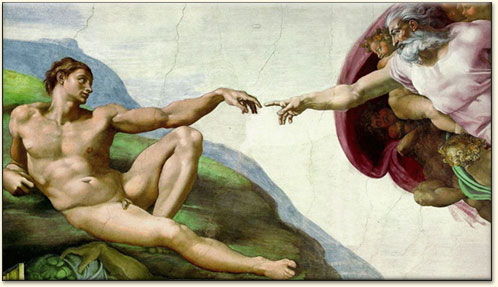
Here are some of the examples that he explored. Look for the Ω curve and see how it defines the characteristics of grandeur and loftiness.
Han Gan's Pasturing Horses

Michelangelo's Creation

Hagia Sophia in Instanbul, Turkey

After the presentation, we were able to see Dr. Leong's calligraphy, and it also incorporates the Ω curve in order to give it the feeling of energy that the calligrapher puts into his work. His demonstration truly showed how Chinese calligraphy uses the body's "chi" (energy) in order to create this feeling!


This was done in a matter of seconds!
You can see more of his work at The Nelson Gallery.
Photo Credits:
Wikipedia
Web Exhibits
CNIDUS
Amanda Yib
Amanda Yib
Let me first introduce Dr. Lampo Leong, the professor of art in painting and drawing at the University of Missouri at Columbia. He has studied in both China and the United States for a number of years, allowing him the experience of both cultures. This bi-cultural understanding of both the east and the west is what has inspired him to study the similarities in both western and eastern art, particularly the persistent presence of the omega (Ω) curve in famous works of art around the world.
Dr. Leong explained how the Ω curve was a symbol of loftiness and grandeur in visual art because of the its shape and contours, which give off a sense of liveliness and sublimity. The fullness of the Ω curve imitates nature in that living creatures appear to be "fullest" at their peak of life, as opposed to being "deflated" when they are older. He compared a newly inflated balloon to one that was days old, and pointed out the difference in shape. The newer one had a very similar shape to that of the Ω curve, and so do things in nature, such as ripe fruits, and young people (as compared to the elderly).
I found his study to be very engaging because the points he made were obvious, yet I had never quite paid attention before. The design of Ω curve is one that is universally because it is one that is found in nature. Artists in both eastern and western culture had realized that this shape was one that connoted life and loftiness, which can connect to spirituality.
Here are some of the examples that he explored. Look for the Ω curve and see how it defines the characteristics of grandeur and loftiness.
Han Gan's Pasturing Horses
Michelangelo's Creation
Hagia Sophia in Instanbul, Turkey
After the presentation, we were able to see Dr. Leong's calligraphy, and it also incorporates the Ω curve in order to give it the feeling of energy that the calligrapher puts into his work. His demonstration truly showed how Chinese calligraphy uses the body's "chi" (energy) in order to create this feeling!


This was done in a matter of seconds!
You can see more of his work at The Nelson Gallery.
Photo Credits:
Wikipedia
Web Exhibits
CNIDUS
Amanda Yib
Amanda Yib
Subscribe to:
Posts (Atom)